Sunday, November 10, 2019

Sue

Sue and Steve in Rockford, Ill., circa 1958

My mother loved to exaggerate.  She was the Renoir, Picasso, and Dali of her art form.  She fibbed, she embellished, she imagined, she went to great lengths in telling her story. That is what I most fear in writing my sister's eulogy: exaggerating the tales of an unbelievable life.

Susan Sara Cowan died at 2:11 pm on Wednesday, October 23, in Tucson, Arizona, after a short illness--or, rather, the culmination of several long illnesses.  She was in hospice care and knew little if anything about her situation.  She had broken both of her hips in the previous month and had had two surgeries, and her body had finally closed down after the second one, after years of fighting epilepsy, schizophrenia, and advancing dementia.

Over the last five decades I have related some of Sue's adventures to friends, but I've never told the whole story.  I will try to minimize the boring details and not exaggerate details that are, in reality, difficult to fathom.  I am sure to leave parts out that I've forgotten, but I still recall most of what she did in her life.

Sue led the most unusual, singular life I've ever known.  See if you don't agree.

Early Years

Sue was a tomboy.  Being only eleven months younger than I, she grew up almost in my shadow.  We were always together, and my friends just accepted her as one of the guys.  She was very good at baseball, basketball, and touch football.  She threw a ball right-handed, but kicked a football left-footed.  Our father had forced her to be right-handed, but her ambidexterity helped her throughout life.  She and I were constantly together.  When we couldn't play outdoors, we created our own games, collected baseball cards, played chess, read childhood mysteries, and tormented our dogs, Buddy and Peppy.

Just a day after Sue turned nine and three weeks before I turned ten, we met our half-brother, Mike, for the first time!  The photo below was taken in our backyard, probably on September 5, 1959.  Mike was nineteen and going to college in Detroit, and we adored him.  Sue and I are wearing our summer baseball uniforms from the Walker Wildcats, the neighborhood team my mother organized.


Sue and I grew up in a fairly poor family, although we always had enough food and clothing.  We shared a room together until our family moved to a larger house in Rockford just before she turned ten, in 1960.  Regardless of where we lived, Sue had very few friends except for my friends.  When I renewed contact with my best friend from childhood, Len Schmeltzer, in 2019, he recalled Sue as being "pretty and feisty."  That was Sue.

An average student, Sue was often criticized by her teachers as "not applying herself"--not trying her best.  My grades in school set too high of a standard for her to match, and perhaps her feistiness came from her wish to be recognized on her own merits.  Of course, none of the kids knew she had learned to play chess at age 5.

Teenage Years

One day Sue and I were playing basketball in our family driveway, when she crouched down as if she were dizzy.  She had to pause for several minutes before we continued playing.  She was about thirteen years old, to my best recollection.  It was her first epileptic seizure--not a grand mal seizure but a rare form of epilepsy where the seizure only occurs inside the brain.  Years later Sue described it as "two great armies having a battle" in her head.

Sue did not tell anyone about the seizures for over three years.  In fact, she had self-diagnosed it by the time she told our mother.  Sue had had bacterial meningitis when she was a baby, and she thought that had led to the epilepsy as a teenager.  Regardless of the cause, Sue's personality changed almost immediately.  She became much more intense and began doing things by herself, not being tempted to follow in my footsteps any longer.  Our parents imagined that she was a rebellious teenager, but I knew there was something else going on with Sue.

My first memory of Sue after the onset of her epilepsy was a day when she came home from school and told us that they'd studied the Declaration of Independence in social studies class.  She then proceeded to recite the entire Declaration, without notes.  It was astounding (and somewhat irritating to my parents).  Sue had a good memory, but not that good.  The epilepsy had changed her brain to be able to recall everything--not a photographic memory, but a complete memory.  It also made her a quieter person, because she couldn't understand her seizures and wanted to hide them.

Over the next five or six years, until our father died when Sue was eighteen, she carved out a pattern of living that stayed with her until she died.  When she found something that interested her, she'd focus on it intently for the joy of personal accomplishment, and ultimately she'd abandon it, when she knew she could master it.  This pattern played out in many ways during her teenage years.  Here's what I recall about those activities:
  • When Sue was eleven, our father taught her to play golf.  I had already been playing for a year, and she wanted to join Dad and me on our weekend golf outings.  In the winters we would go bowling with our father, but in the spring that would switch to golf--and we played a lot of golf together.  Without any formal lessons, Sue got really good, and she won two city-wide women's golf tournaments for her age group.  She stopped playing when she was sixteen.
  • Sue was about thirteen or fourteen when she got her first guitar as a birthday gift.  She already loved folk music, especially Peter, Paul and Mary albums.  Quickly she taught herself how to play guitar; her finger-picking abilities were extraordinary, and she learned to play most of their songs.  She also played the music of Donovan, Eric Andersen, Phil Ochs, and Judy Collins.  By the time she was sixteen, she began performing in school talent shows and the area coffeehouse, Heather on the Moor.  Her singing was not great, but her guitar-playing was superb.
  • Sue always loved to read, but after her first epileptic episodes she began reading the family's encyclopedia.  She'd pick out one of the volumes, open it, and start reading.  This led to a game we started playing with our good friend, Jill Meyer, during summer break.  We composed our own Jeopardy! boards and tailored the format for three people, each giving answers and asking questions.  I'd give a clue from my board, and Sue and Jill would race to answer it.  Then Sue would give a clue from her board, and Jill and I would compete, etc.  We'd play our game in the morning and spend the afternoon creating our boards for the next day.
  • When I was sixteen and Sue was fifteen, we wandered into a used bookstore called "The A" and met the owner, Paul Anderson.  "The A" stood for "The Arts."  Paul had already graduated from college and had opened his eclectic bookstore with thousands of his own books.  He always had classical music tapes playing and two or three chessboards set up in the store.  He sold his books and anything legal that a hippie might buy--posters, beads, pipes, incense.  We were beyond captivated and spent many, many hours there with Paul.  Sue and Paul played chess continually, and Sue set aside her encyclopedic reading for serious books.  She tore through Faulkner and Hemingway and Wolfe, Shakespeare and Pinter and Beckett, Plath and Whitman and Eliot.  Paul introduced Sue to Bertrand Russell's writings, and Sue dove into philosophy, devouring the books of Nietzsche and Kant and Schopenhauer.
Sue didn't do anything half-way.  She didn't dabble.  If something interested her, she dove in, much to the detriment of her school studies and social life.  She refused to follow anyone's lead unless it was in something she was totally interested.  That was part of the pattern for the rest of her life.

New York City

Sue never considered going to college.  She said it would slow her down, that she could teach herself much faster than a college professor could.  My father learned that he was terminally ill the week that Sue graduated from high school in 1968, and he spent most of his remaining time in the hospital, so he didn't encourage her to go to college.

Not knowing what she wanted to do, Sue opened her own little bookstore in Rockford the summer of 1968.  Called The Book Nook, it carried only the classics.  She had few customers, which was fine with her, because it gave her more time to read.  Sue closed her bookstore a couple of months after our father died in December, 1968.  She took her two guitars and headed for Greenwich Village in about February, 1969, when she was eighteen years old.

I don't know why Sue chose New York, because she could more easily have chosen Chicago for her folk singing endeavors.  I think she wanted to totally get away from Illinois and live on her own.  She found a tiny apartment on Jane Street in the West Village, and she quickly located all coffeehouses within walking distance.  She began playing at Cafe Feenjon and The Olive Tree Cafe.

She lived over a decade in New York City, interrupted by a month in San Francisco in the late 1970's.  Here's a synopsis of her activities:
  • Sue did continue to play her two Martin guitars and even began writing songs.  She played in coffeehouses and busked on the streets for spare change.
  • Sue's first job in New York City was working as a taxicab driver.  She liked the work because she could "check out" a cab any time of day or night and drive as long as she wished.  She was initially told to not drive outside Manhattan, but her first fare asked her to drive out to JFK Airport, and he'd give her directions!  She made it to the airport and back within an hour, with two fares and $40 in tips!
  • Soon after arriving in Greenwich Village, she met an older man named Yonnel, who ran a chess studio.  Sue dove into studying chess, which came very quickly to her, since she could easily memorize historic chess games.  At one point I asked her how many chess games she had committed to memory, and she said, "Oh, about 10,000."  I asked her to show me some, and she did.  She would quickly move through a game by Capablanca or Tal or Fischer.  (She actually played Bobby Fischer a couple of times in Greenwich Village coffeehouses, always playing to a draw!)  Sue specialized in "speed" chess--playing three- or five-minute games against an opponent and a clock, often for money.  When I visited her in the summer of 1970, we spent a lot of time in chess studios.
  • For steady work Sue got a job as a typesetter at a small publishing company.  That allowed her to set her own hours and work at her own speed.  As a manual typesetter she was also allowed to do the work of a copy editor, fixing typos and grammatical errors.  That was right up Sue's alley, because she was already an expert in grammar and word usage.
  • Sue did write some songs, which were fair, but her main writing interest was fiction.  She wrote part of a novel, called "The Book," and sent a couple chapters to me.  It was a combination of fiction and philosophy, and it was very well written.  The book posed some very interesting questions.  What would happen if you answered a knock on your door one day, only to find a book left there that was the script of your entire life?  How much of it would you read?  Would you finish it?  The novel confronted those questions.
  • Sue was "mugged" multiple times while in New York City, so she decided to take up karate to defend herself.  She chose the Shorei Kan system in the Okinawan Goju-Ryu karate tradition.  Goju-Ryu stands for "hard soft".  Sue achieved second-degree black belt in four years of work.  Her sensei was the founder of Shorei Kan karate, Seikichi Toguchi, shown in this photo:
    • Sue was asked by her sensei if she would accompany him to Okinawa to give a demonstration at an international karate exhibition.  While there, she was given private instruction in Okinawan weapons at a Buddhist monastery.  She was also given a special invitation to lead a karate calisthenics class at the U.S. Marine Base.  The Marines thought it would be easy and even laughed at the prospect of a woman leading their calisthenics, until she explained that the first exercise would be fifteen push-ups done on fingertips, each push-up four minutes long.  She told me the last Marine dropped out after about twenty minutes, and she alone finished the hour.  Everyone paid attention to her after that. 
    • When Sue returned to New York from Okinawa, she concentrated on Okinawan weapons kata (exercises).  There were six weapons (bo, tonfa, sai, kama, nunchacku, and one other I don't recall), and she became a black belt in each one.  Okinawan weapons were derived from old farm implements.  She would practice in Washington Square Park, and I would watch her when I visited.  In fact, lots of people watched her run through her exercises, and only one person attempted to disarm her, thinking she was only for show.  She bonked him hard on the shoulder, and he ran off.  Below are photos of Sue practicing three different types of weapons—tonfa, sai, and bo.


      • As Sue got better and better in karate and weapons, she decided to offer private instruction to students.  All sessions were done in Washington Square Park, where you could find people playing guitars, playing chess, doing drug deals, or enjoying a comfy park bench.  Here's the business card that Sue had made to advertise her services:

      • In the mid-1970's, Sue determined that she needed more physical exercise, so she began running long distances.  She'd do loops around Washington Square Park's eight square blocks, often running six or eight miles.  She did this almost every day.
      • Studying was always Sue's main focus.  Between her chess and karate phases, she mostly stayed in her tiny apartment and read books.  On one visit, I noticed that friends of hers would bring food and books, so she didn't have to leave her apartment.  She taught herself enough to read books "in their original form," which meant that she could read in Hebrew, Aramaic, and German, in addition to English.  At her most intense period of studying, she was reading five books a day!  I witnessed that this was pretty easy for her.  During this phase in her life, she told me that studying was the only thing that ever gave her true enjoyment in life--and she could be studying anything.
      • For light recreation, Sue earned some extra money by composing chess problems for various magazines.  The harder the chess problem, when verified by masters, the more money she'd make.  She'd typically do the "White mates in three moves" problems, but occasionally she'd do a "White mates in four moves" gem.  A couple times she showed me her all-time favorite chess problem done by someone else--"White mates in eight moves!"

      Of the several times I visited Sue in New York, she always lived alone in a small apartment.  She was primarily asocial; she didn't have time for other people, although she enjoyed my occasional visits.  We would typically talk for several hours without a break.  We might talk about mathematical puzzles, chess problems, classical music, our parents and childhood memories, her noisy neighbors.  All we needed was some coffee and floor space to weave a conversation that lasted all afternoon or evening.

      When I think of my visits and our marathon chats, the photo below is iconic for many reasons.  Sue smoked her entire life, from when she was 18, and her drink of choice, if not coffee, was Pepsi.  Her only source of entertainment was a radio and cassette player.  The radio was usually tuned to the local classical music station, and it played twenty-four hours a day!  (Not surprisingly, her favorite composer was Mahler, who led an angst-filled life.)  Also, while in New York City, she kept her Okinawan weapons mounted on the wall of her room and within easy reach.  She always slept on the floor or on a very thin futon cushion.  This is Sue at her most relaxed, "I'm at home" pose.


      Jerusalem

      In the early 1980's, Sue became disenchanted with Greenwich Village.  Even for Sue, it had become too dangerous and toxic.  Her studies had evolved from novels and philosophy to the next logical area--religions.  She and I had grown up in the Reform Jewish faith, although neither one of us had been devoted to it.  She did a cursory study of Buddhism and Hinduism, but what really captured her was Orthodox Judaism.

      Before making the decision to move to Israel, Sue became a practicing Orthodox Jew.  She ate only kosher food and did morning prayers, using the Tefillin boxes and straps to wrap her head and arm.  We never discussed her return to Judaism, although I thought it was more of an intellectual journey than a religious one.  Sue bristled at the suggestion that anyone or anything could determine her life path; she attacked something purely from the joy and challenge it brought her.

      Since Sue always had very few possessions, explained by her as "traveling light" in life, moving to another country was not a big deal.  She already had a passport from travels to Europe and Okinawa.  She sold her guitars and weapons, gave away her sparse furniture and bedding, packed her few clothes, and got on a plane for Tel Aviv.  Her plan was to find a small apartment in Jerusalem and to look for a part-time job.  I believe she traveled with a friend, who stayed for a week or two before returning to New York.  Below is a photo of Sue when she arrived in Tel Aviv's airport.
       

      For the most part, Sue communicated "newsy" letters with our mother, but I heard very little from her while she was in Jerusalem.  [I may add to this blog when I find letters my mother saved from Sue's travels.]  What I know about Sue's three- or four-year stay in Jerusalem, which I found out from her after her return, were the following remarkable points:
      • Sue pursued her interest in Judaism and, in particular, Orthodox Jewish law, as avidly as she had pursued every other endeavor in her life.  She studied the Talmud especially, which is written in Hebrew and Aramaic.  The Talmud is the primary source of Jewish religious law and practices.  She spoke mostly Hebrew and Yiddish in Jerusalem, with some Arabic mixed in.  She began to dream in Hebrew, she said, which was her criterion for really knowing a language.  Most remarkably, she became such an authority on Jewish law that she often had rabbis come to consult her interpretations of the Talmud.  This was technically forbidden at the time, because women could not be Orthodox rabbis or scholars.  Sue didn't care about rules!
      • Because she couldn't find the same degree of intellectual stimulation in other endeavors as she had found in New York City, on a whim she began to study thermonuclear physics!  I asked her why she chose that, and she said she was bored and needed something completely new to study.  After six weeks, according to her story, she went to the Hebrew University of Jerusalem, one of the top-ranked research universities in the world, to be assessed.  They evaluated her knowledge and told her that she was ready to begin her PhD thesis.  That was Sue's normal pace in acquiring knowledge.
      • Sue explored Jerusalem thoroughly and eventually met members of the Jewish Defense League (JDL), which is a radical pro-Israeli group.  She did not like what they stood for, nor did she join them, but she learned much about them.  She did not like the violence they proposed for solving problems; her mastery of Shorei Kan karate was fundamentally based on the concepts of non-violence.
      Sue moved back to New York City a few years after she'd left.  She confided in me that the main reason was the amount of anti-Semitism she found in Israel.  It exceeded any other place she had visited.  Jews of one sect hated Jews of another, and there were dozens of neighborhoods and sects.  It so disillusioned her that she ended her study of Jewish law and daily Orthodox practices.  She would rather put up with the dangers of Greenwich Village.

      Tucson

      In the mid-1980's, Sue's epilepsy got worse, turning into grand mal seizures, and she was forced to take medication for the first time.  She'd always resisted taking medication, because the side-effects would dull her mind.  She would no longer be able to learn disciplines at a fast clip, at least not as fast as she'd like to.  After she'd returned to New York City for a short time, she decided to move to Tucson, Arizona, because the medical center there was known for its epilepsy research.

      It was in the early 1990's when I visited her in Tucson to find out her situation.  The place where she lived was safe and secure, but I was shocked at all the Post-it notes she had placed on her cinder-block walls.  She explained that her short-term memory was really damaged, and she had created a system for handling her memory issues.  She kept copious notes and a diary for everything, and she would often consult them to remember something.

      Sue was also occasionally delusional on those visits, telling me things that I knew had not happened.  It made me question whether things she'd told me in the past were really true, but I also had proof that they were, mostly in photographs, letters, and statements from other people.  That was the thing about Sue--the things that happened in her life were so fantastic that one could easily think they were fantasy.  Unintentionally, I had already substantiated most of what she'd told me.

      When she reached Tucson, her life became more "normal".  She wasn't a stranger in a strange land, as the book title states.  She had met a very odd fellow while playing her guitar at her "station" on a Tucson street, and he helped her get settled in Tucson.  He took this photo of her.
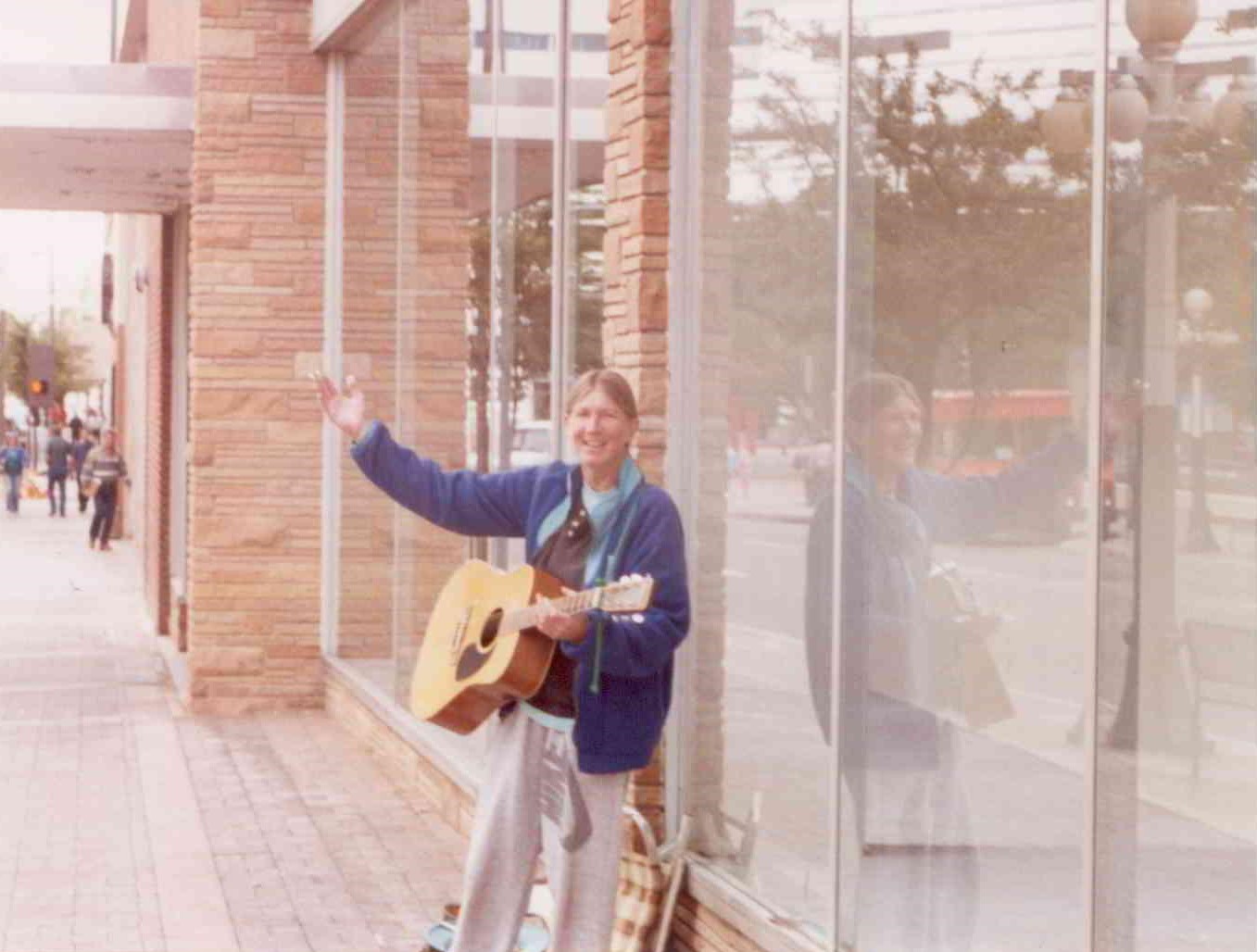

      Sue was not like other street musicians; she had transposed several Bach pieces for her guitar, and she would play them at his request.  He turned out to be an attorney, and he helped Sue find safe places to live.  Although she didn't like the hot summers, Sue did like Tucson very much.  She knew the bus routes, spent a lot of time at the University of Arizona main library, and found people to play chess with, including the attorney.  People were relatively sane, compared with New York City.

      One day Sue got angry at her apartment manager and started swearing at him.  She was promptly told to vacate, and so the attorney found her another place to live.  This studio apartment was much more convenient for Sue, because it was next door to a grocery store and on a major bus line.  Here are a couple photos in her studio.


      Although her seizures really limited what she could do in her life, she did partake in a couple of truly remarkable activities.
      • Sue decided to learn to knit, which led to her extensive interest in crocheting.  She worked non-stop on each new project, and soon she decided that the common stitches were boring, so she began to develop her own.  She showed me many formulae that she had devised for her own stitches, and she sent me a couple of her larger pieces.  Below is a photo of some of her smaller projects.  You can see the complexity in the stitches she developed.
      • For the last ten or fifteen years of her life, Sue returned to studying philosophy and linguistics on her own.  She had once been interested in creating her own language but decided to focus on several existing languages.  She and I had long amused each other by trading linguistic and language puzzles we came across.  (She gave me this puzzle first:  Name a set of homonyms in which there are four words.  Answer:  Right, write, rite, and wright.  I later came up with a second set of words: Raise, rays, raze, and res.)  Sue began to study the only linguistics philosopher who challenged her--Ludwig Wittgenstein.  She read dozens of books and made hundreds of pages of notes on Wittgenstein--probably all of them unintelligible to anyone except her.
      Last Years

      In the last three or four years of her life, Sue declined very quickly.  My wife, Suzanne, did an incredible amount of work for Sue, providing her with food, transportation, doctor appointments, and cell phone.  Sue was on Social Security Disability from about 2000, and I set up a bill-paying service for her that gave her a weekly “allowance”.  The various medical agencies in the Tucson area were excellent, and finally one agency stepped in and obtained housing for Sue in an assisted living facility.  Unfortunately, in that moving process, all of Sue’s notes, diaries, and small crochet items were lost somehow.


      In our last few visits, Sue and I mostly enjoyed reminiscing about our childhood.  She remembered those years quite well.  She remembered less well her years in New York City and Jerusalem.  I would bring up a particular incident that she'd once told me about, and occasionally she'd recall it.  Then something would spark in her and she'd suddenly recite a very long poem or demonstrate one of her chess compositions.

      Sue was a remarkable person for her personal accomplishments, but she was never interested in applying her brilliance to significantly help other people or contribute to the world.  She was never interested in marriage or having children, nor was she interested in academia or earning a degree.  She had no interest in the business world or working a nine-to-five job.  She earned money seven different ways in her life, as a bookseller, taxi driver, print typesetter, club and street guitar player, speed chess master, karate instructor, and Jewish law consultant.

      Sue did have an odd view of the world.  Seldom did she really know what was happening outside her own existence, nor did it ever occur to her to go out of her way to help others, not out of meanness, but out of not understanding the worth and benefit of such actions.  I think of one particular anecdote....

      At one time she decided, while in New York City, to take a two-session class to learn CPR and the Heimlich Maneuver, in case she might ever see someone "choking in a restaurant or dying on the street."  When she got to the first session, they asked for her $40 fee for the class, and she was totally stunned.  She honestly thought they'd be paying her, because she would then be able to help other people.  Immediately she walked out in a state of complete indignation.  When she told me that story, she was still indignant.  That was Sue.

      I still have old letters, many photos, and two or three afghans that Sue crocheted, and I still have a thousand memories.  One of my favorites is a story I've told to many people.

      In about 1972, Sue and I both decided to surprise my mother for her birthday without telling each other.  She flew in from New York City, and I drove up from Champaign-Urbana to Rockford.  We arrived within the same hour and were delighted to see each other as well as our mother.  After dinner and a couple hours of chatting, our mother went off to bed, and Sue and I continued talking.  This is how the conversation went:

      Steve:   Sue, I have to tell you about this incredible dream I had this morning.
         Sue:   You dreamed about when you were in kindergarten and built little toy ships--and how ironic it is that you went on to compose The Ship.  [It was exactly what I had dreamed!]
      Steve:   How did you...how did you know that?
         Sue:   Oh, that was pretty easy.  You've been thinking about it all night.

      What could explain the event but that she had read my mind?  The dream had been especially vivid.  I had not consciously thought about kindergarten for many years, and I had completely forgotten about the little toy ships I built in that basement classroom, before I had the dream.  And, I had not had the chance to tell anyone about the dream, since it had only happened that morning, before I drove 185 miles to see my mother.

      Sue proceeded to tell me about a group she was part of in Greenwich Village.  They would get together every week and practice reading each other's mind, and she'd become good at it!  As the weekend progressed, she read my mind a couple other times, much to my amusement.

      Sue was the epitome of "practice makes perfect" throughout most of her life, whether it was guitar-playing, chess, martial arts, linguistics, language, crocheting, or mind-reading .  I guess that's how I'll remember her.


      Saturday, May 5, 2018

      The Lamp


      As long as I can remember, I've loved looking at stained glass--windows, lamps, trinkets.  Our Jewish temple had some old stained glass windows that I would look at when I was a kid.  They looked dirty and dull from the outside, but they came alive when you looked at them from inside the sanctuary.  They held my attention more than anything else on Sunday mornings.

      It's odd that I did not try my hand at making stained glass objects until I was 42 years old.  I had been immersed in other art forms--music, writing, dance, ceramics--but when I saw a beginning stained glass class offered in a community education brochure one day, it seemed like the right time in my life for it.

      My first stained glass class was in the fall of 1991, when I took a very basic, 4-week class in which I completed one object--a blue butterfly with about 5 pieces of glass.  We learned to cut the glass (and our hands!) according to a printed design, cover the edges with copper foil, and solder the pieces together.  The butterfly is long-since lost, but I still remember how difficult it was to do and how proud I was to finish it.

      The class was taught by an instructor named Brian Helgerson, and we hit it off immediately.  He was a master glass craftsman who owned a shop called Sundance Glass, so I decided to take classes from Brian at his shop after the community education class was done.  That class started on Thursday night, November 7, 1991, which happened to be the day that Magic Johnson retired from the NBA, according to my always-handy calendar.

      Glass Fusing

      From the moment I stepped into Sundance, I was enthralled.  There were so many glass works on display and for sale, so many colors and shapes and sizes, with pieces of glass in every nook and cranny.  There were 2' x 3' sheets of glass stacked vertically on shelves, counters filled with supplies you might require, rotating spindles with all types of books about glass-making.  The front room was Brian's retail shop, but you could readily view the very large back room studio with rows of work tables, glass-firing kilns and unfinished projects scattered everywhere.

      With a class of about eight people, Brian chose to first give us a glass fusing assignment.  He showed us how to cut glass properly.  We could choose from several available colors and were asked to cut different shapes and to place them in some cohesive design, with smaller pieces laid upon a larger background piece.  I chose to make an abstract form of an exotic flower, which is about 5 inches wide.  The white, pink and green pieces (below) were laid upon the dark red piece of glass for the firing.


      Our little designs were fused in the kiln and waiting for us the next week.  Because the glass is fused to a very high temperature, all of the sharp edges disappeared as the pieces fused together.  You never really know what you're going to get with a glass fusing project until it comes out of the kiln.  I was quite pleased with the result, and this little flower has sat on my desk for the last 27 years.  Still, glass fusing was not the goal for me, so this was the only fused piece I ever did.  I wanted to get into making real stained glass pieces.

      Hummingbird

      Our second project was to be a small stained glass piece that did not require firing in a kiln.  Brian had dozens of design books from which we could choose a simple pattern, and I chose to do a ruby-throated hummingbird.  It looked simple in the book, but it turned out to present many challenges.  After tracing the design onto a sheet of white paper, I was ready to begin.


      I chose the glass I wanted to use--small pieces of white, red, black, dark green, and a variegated green glass.  The white and variegated green pieces allowed a lot of light to shine through them, while the other colors were more opaque.

      When you cut glass, you first use a tool to "score" it, which leaves a very shallow, scratch-like line in the glass.  Then you hold the glass on either side of the score line and snap it suddenly and with just the right amount of pressure, and hopefully the glass breaks cleanly along the score line.  However, there are many potential problems in doing a small design like the hummingbird, which measures about 10-1/4 inches from wingtip to wingtip.  I quickly learned about these issues:
      • Glass wants to break in a straight line, not a curved line.  When you add the score line, the break will follow that line if it is very gently-curved, because you've slightly weakened the glass along that line.  The break will not follow a sharp curve.  To achieve the shape of the hummingbird's tail, I first tried to create the approximate shape of a diamond, and then I used a glass grinder (wearing goggles!) to grind away excess glass to achieve the convex curves on the sides and bottom and the concave curve on the top.  Using a grinder takes a lot of time; if you press the glass too hard against the grinder, it will break, and small shards of glass can easily splinter away.  Smooth curves are usually accomplished by using a grinding or sanding instrument.
      • Larger pieces of glass are much easier to cut than smaller pieces of glass.  The hummingbird's beak, although formed by straight-line cuts, was very difficult to make, especially near the tip.  You can break several pieces of glass before you achieve the exact shape you want.  The most difficult piece to cut for the hummingbird was the upper right piece on the wing, because it had two thin, sharp points.
      • After you cut each piece of glass, you put copper foil around its entire border.  The solder will then adhere to the copper, not the glass.  Brian only taught the copper foil method of holding pieces together, not the pre-formed, leaded groove method.  Copper foil can be very difficult to work with.  Again, the sharp points presented the biggest challenges when foiling the glass pieces.
      • It takes a lot of practice to be good at soldering glass pieces together.  You have to work at just the right speed--too fast and your solder lines will be too thin and have gaps, while too slow will result in solder lines that are lumpy and irregular.  If the solder gets too hot, it becomes too liquid and drops between the foil cracks!  The solder line around the white body of my hummingbird is pretty good, because it has an even shape and texture around the whole border.  However, the solder is a little too thick around the red throat and the end of the black beak.
      • Notice that the eye of the hummingbird is a dollop of solder, and the two chain eyelets are also attached with solder.  Doing anything fancy with solder is a real challenge.
      All in all, I was quite happy with the hummingbird, and it has held together and been used as a light-catcher in a window for many years.  The picture below was taken on a cloudy day, so the colors are still somewhat muted, but it does show how striations in the glass give the impression of activity and movement, as if the hummingbird has been caught in mid-flight.


      This piece also taught me a great lesson about stained glass colors.  Not only do the colors change in different light conditions, but they must work together in any light condition.  Notice how much more yellow comes out in this half-light setting, unlike the first photo.  I love the surprising changes in color that you see with stained glass.

      Tulips

      Although the hummingbird project only involved 12 pieces of cut glass, I chose to work on a tulip window design containing 67 pieces for my next project.  A new class was beginning at Brian's studio in January, 1992, and he encouraged me to do a larger project that presented more challenges.  I also met another glass artist, Shannon Kindle, who had her own studio right next to Brian's studio.  Since Brian's studio was often open during the weekends and I was free to work there, I often visited Shannon to ask her questions or see her incredible glass projects.  She specialized in complex glass sandblasting projects such as walk-in shower doors or restaurant room dividers, and her creations were unbelievably beautiful.

      The tulip project presented different challenges and called for new techniques.  The border of the window was built with grooved metal strips for the glass to fit in.  The top and left strips were first soldered together at a right angle, and they were secured to a large breadboard so they couldn't move.  I had found the tulip design in a book and had expanded it on paper (using a copy machine) to be about 15" by 21".  That design was pinned to the breadboard, and the metal border strips were cut to fit the circumference of the design.

      Then I began to cut and place the pieces of glass on the paper, starting in the upper-left corner and working toward the bottom-right corner.  For the first time, I was using clear glass for part of my design, so I had to choose a piece of glass with no flaws in it.  The green and red sheets of glass were both chosen for the degree of texturing in the glass.  The green glass had long streaks of texturing in it, which was perfect for the tulip leaves and stems.  The red glass had a little less texturing, perfect for the tulip bulbs.


      Many of the glass pieces were long and narrow, and those are especially easy to break in half if you're not really careful, so my glass cutting and snapping techniques had to improve from what I did in the first projects.  Again, as each piece was cut, I used copper foil on the edges for soldering later on.

      I should explain the foiling step more precisely.  If you imagine the glass to be 1/8-inch thick, the foil, which is sticky on one side and a thin layer of copper on the other, should be a little wider than the glass thickness--perhaps 3/16-inch wide.  You would place the foil evenly around the edges of the glass and fold the foil onto the glass on either side.  If folded perfectly, this would leave 1/32-inch of overlap on each side of the glass.  When two adjacent pieces of glass are properly cut and placed together, their edges should exactly touch, and the copper foil will then provide about 1/16-inch of surface for the solder.  If the pieces are not cut properly, gaps will appear between the copper-foiled edges, and you don't want that.  Notice in the photo below how the seams are very even and narrow.  Each seam is really two pieces of copper foil lying against each other!


      This detail photo also shows how the pieces of glass are fit into the metal strip and the solder lines go right to the metal strip.  This provides a very solid fitting for the glass.  Please note that the tulip window is set inside one of our kitchen windows, so part of what you see is the kitchen window itself.

      I worked about 50 hours on the tulip window.  All of the pieces were cut by March 5, 1992, and they were all soldered by March 14, 1992.  That was before I moved into my current house and discovered how perfectly the tulips fit into our kitchen window.  If I ever were to take up glass cutting again, I'd do another window of the same size to fit our matching kitchen window.

      Tiffany Lamp

      Once I had completed the tulip window, I decided I was ready to tackle a much larger project, so I began Brian's stained glass lamp class on March 24, 1992.  My ultimate goal when I began working with stained glass was to do a Tiffany lamp, and I thought I had the skills to do one after working with tulips for weeks.  Each Tuesday evening class lasted for 3 hours, and I was free to work in the studio on Saturday and Sunday afternoons, so I began to keep a log of all my hours spent on the project.  Little did I expect to spend almost 300 hours on the lamp before it was finished!

      Brian carried a line of fiberglass molds which were imprinted with original Tiffany designs, and I chose Tiffany's famous pansy design.  If you google "Tiffany pansy lamp," you'll see many versions of the same design.  Below is one of many available on the internet.  The vendor quotes 25 days (200 hours) to make one lamp, and I'm not surprised.

      If you compare the above example with my lamp (below), it's easy to recognize that they're from the same design, but there are a couple of striking differences between the two.  The flowers above don't look much like pansies to me, so I added an inner ring of color to each flower.  My blue flower, for instance, has an inner white ring of color and a yellow center, which looks more like a pansy.  In addition, each of my full flowers has five petals, while it's hard to distinguish the number of petals for each flower in the above lamp.  I wanted each flower to stand out, so I chose different colors for adjoining flowers.


      The overall lamp has four identical quadrants, so every piece you see is repeated four times.  There are no guidelines in the instructions or on the mold as to what colors you should use, so I chose all of my own colors and did not repeat them from quadrant to quadrant.  Note that my background color is uniform (a cream color) for the whole lamp, while the background color on the sample lamp is darker near the lower rim, perhaps giving the impression of the pansies lying in a green garden.  Since the internet didn't exist 26 years ago, I really had no guidelines for choosing colors, and you'll see a wide variety of color patterns on the internet.

      There are other notable differences between the two lamps.  I like that the studio's lamp uses three shades of green for the leaves and stems, where my lamp only uses one shade.  Also, I interpreted some of the smaller interior pieces (like the piece immediately below the pink flower) as being the background color bleeding through, which I think defines the flowers, leaves, and stems a little bit more.  Finally, the sample lamp had glass available that was a little more textured (variegated).  Only my blue flower shows much shading within each piece.  Regardless, I'm very pleased with the colors I chose for my lamp.

      I remember Brian told us that there used to be hundreds of glass companies in the United States, but in 1992 there were only seven or eight left.  He sold glass from the Bullseye Glass Company in Portland, Oregon, still thought today to be one of the best sources of glass in the world.  I had the pleasure of visiting the Bullseye store once in Portland, and it held all of the magic of a music store for me.

      Work progressed slowly on the lamp, primarily because there were so many tiny pieces, each one of which had to be cut, shaped with a grinder, and foiled.  The centers of flowers were especially hard to cut and foil.  I used two sizes of copper foil.  Where I wanted very thin solder lines, such as in the centers of flowers, I used a very narrow foil.  As I would finish each piece, I would stick a very tiny ball of wax on the back of the glass and stick it to the mold.  None of the soldering was done until all of the 700+ pieces were cut, foiled, and stuck to the mold.  In this process, I was very careful to not leave any gaps between adjoining pieces; they had to be cut and foiled just right.


      Above is a photo of me working in Brian's studio, probably on a Saturday afternoon.  The lamp at this point was more than half done, and so you can see lots of copper-foiled pieces stuck to the white fiberglass mold in front of me.  (None of the pieces had been soldered together yet!)  To my right on the table are several glass-cutting tools, and in the foreground you'll notice the lid to a cardboard box, which contains lots of miscellaneous pieces of glass and a larger sheet of green glass, most of which could still be used.  Finally, behind me on the workbench is the grinder I used in the detailed shaping of each piece.  In addition to wearing goggles, the light lamp with its large magnifying glass also served to protect my eyes.

      I worked on the Tiffany lamp two or three times a week for the rest of the year and into 1993.  I finished cutting all of the pieces on March 13, 1993. During the next week I spent about 5 hours doing a rough solder over the entire outer surface of the lamp.  For a rough solder, you don't care if there are small gaps or lumps in the solder; you just want to solder all of the adjoining edges so they'll hold together when the lamp is removed from the mold.  That glorious day came on Saturday, March 20, 1993, when Brian, Shannon, and I used hand-held hair dryers to melt all of the tiny pieces of wax holding the lamp to the mold.  Below is a photo of Shannon and me using the studio's hair dryers on the lamp shade.


      Using the hair dryers to melt the wax is a harrowing process.  It has to be done fast, but not too fast, so that all of the wax stays viscous enough to lift the lamp from the mold.  When we thought the lamp was ready to separate from the mold, all three of us lifted the bottom edge simultaneously, being very careful not to deform the shape.  It worked!  Below is a photo of me holding the lamp immediately after we had lifted it from the mold.  In my hands it felt surprisingly solid, primarily because the pieces fit together so well.


      The lamp shade was stable enough, even after one rough solder, that I could tilt it to catch the afternoon light streaming into the studio.  The photo below gives a good view of the lamp shade's concentric circles and center hole, without the top ring and plate, which were added later.  This is also a nice view of how some of the colors looked in direct sunlight.


      Then began the arduous task of soldering and re-soldering and re-soldering.  Over the next five weeks I spent 26.5 hours on soldering.  First I worked on the entire inner surface of the lamp, as shown in the photo below.  This was not the same "rough" solder method, but a very careful smooth soldering, where I tried to get all of the borders and joints with the desired, consistent "look."  Small pieces had thin solder lines, while the larger pieces had slightly-thicker solder lines.


      After soldering the inner side completely, I went back and soldered the outer surface just as carefully, because both sides had to have even, consistent solder lines!  But that created a problem: as you smooth out a solder line on one side of the lamp, it can thicken or distort the same solder line on the other side, because the solder, when it's hot, wants to drip through to the other side.  So, I returned to the inner side and worked with a very light hand on all of the lines that had been distorted.  Finally, I returned to the outer surface and did the same minor repair work on all of those solder lines.

      When I had finished with the repair work, I had soldered the outer side three times and the inner side twice.  The lines were not copper-colored, but a shiny, light-colored gray from the solder.  The line soldering was finished on April 25, 1993.

      I had combed through many catalogues to find just the right base for the lamp.  As a rule of thumb, the distance between the bottom edge of a lamp shade and the table it sits on should equal the diameter of the lamp shade, so I had to find a base that suited the size of the shade.

      After the line soldering was done, I spent an afternoon soldering the base's top ring and plate to the top rim of the shade.  This was more difficult than it would seem, because the ring had to be exactly level with the shade's bottom rim, so the lamp would stand straight and not tilt.  As with every step in the process, Brian helped me with the leveling, but I did all of the soldering.

      I could have left the solder lines gray, with the idea that they would age and darken over time, but I wanted them to match the bronze-colored base and top plate, so the only thing to do was to carefully apply a bronze patina finish to all of the solder lines--on both the inner and outer surfaces of the lamp shade.  The patina was a liquid that could be applied with a small brush.  The difficult part was making sure that all of the excess patina was wiped off the glass.  I worked for 10-1/2 hours on the patina step, and it was finally finished on Saturday, May 8, 1993.

      The above photo gives a good view of one section of the shade.  What I'm probably most proud of is the uniformity of the solder lines.  Some lines are intentionally thinner than other lines.  If you look at a Tiffany lamp available in any glass store, you'll notice how non-uniform the solder lines are, which indicates that pieces were cut quickly and gaps were filled with solder.  Many times I was not happy with how I had cut a piece of glass, so I cut another piece to replace it.  That is one of the reasons the lamp took so long to make--an average of about 25 minutes per piece.  If I finished cutting 7 pieces in a 3-hour class, it was a good evening!


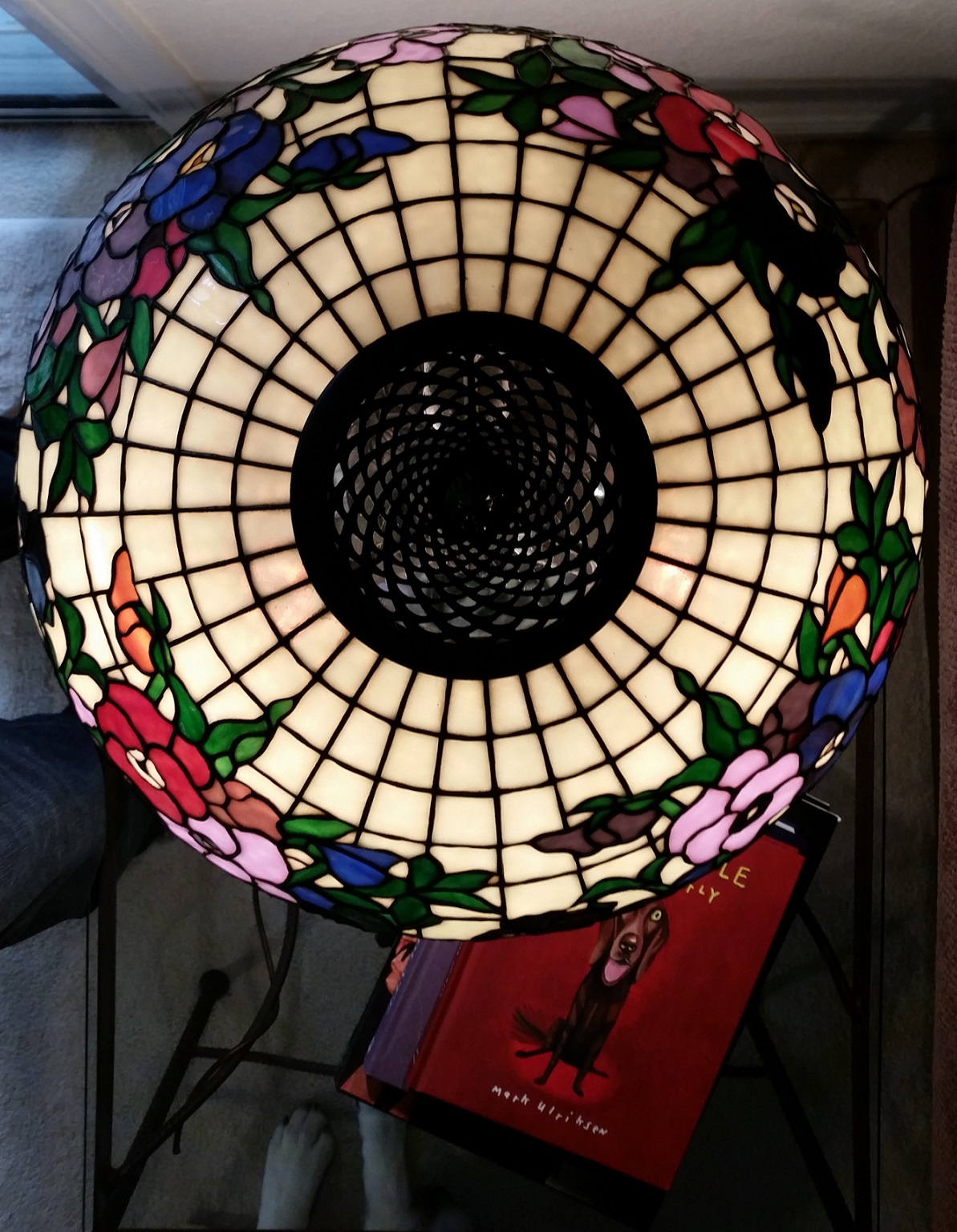
      The official completion date for the lamp was May 8, 1993,  although I didn't actually receive the lamp base until a couple weeks after that.  By then I spent almost 14 months working on my lamp, but it was all worth it.  Above is a photo of the lamp with its bronze base.  We've displayed the lamp prominently in our living room for the last 25 years.  It currently sits on a custom-made, bronze and glass side table (which was made by an artist in Arizona).  In the photo below you can see the top of the lamp and parts of all four quadrants.  Resting on the table are a couple of books, the top one of which is one of our favorites, "Dogs Rule."  Only after cropping this photo did I notice the front paws of our dog, Cooper, below the clear glass table surface near the bottom.  Yes, dogs rule!


      Although most of the work was done in Brian's glass studio, a small percentage of the work was done elsewhere.  For two weeks prior to Christmas, 1992, Brian invited me to work in a holiday retail shop he'd opened, so customers could see glass work in action.  I also worked at a couple street fairs where he had booths, and during those days I never left the lamp shade alone for a minute.  Although it was fun to talk with people about the lamp, I got very little work done those days.

      Usually I absolutely loved the work I was doing, regardless of where I did it.  I used to joke with Brian that glass work is the only activity where you routinely cut yourself and burn yourself and still have fun.  I asked him, long before finishing the lamp, if he'd ever considered just selling his glass work and not running a shop, and he told me that one could never make more than $20 an hour doing that.  The lamp was on display in his glass shop for about a week after I finished it, with a "Not For Sale" sign on it.  Twice in that week he was offered $6,000 for the lamp by glass collectors!  We had a good laugh when he told me about the offers, because we both recognized that my 300 hours of work would have amounted to exactly $20 an hour!

      In Retrospect

      When I finished with my Tiffany lamp, I didn't know that I was forever finished with glass work.  Brian moved his shop soon thereafter.  I thought that I would still do more projects, but then other things in life got in the way.  I had accomplished one of the great goals in my life, and I was satisfied with what I had.  I would never take on a larger project, and smaller projects didn't interest me much after finishing the lamp.

      Making a 700-piece lamp took more patience than anything I've ever done, and so I am probably more proud of it than anything else I've created in my life.  Every day of work presented new challenges.  Many times I had almost finished cutting a piece when it broke and I had to start over with it.  Sometimes I discarded finished pieces because of impurities noticed in the glass.  When I finished the lamp, I thought I had completed my masterpiece.  But, of course, many years later I discovered a single flaw!

      While looking at the lamp one day, I noticed that one of the green pieces should have been the cream color used for the background pieces.  It's the piece shown below with the glint of yellow light in the center of the photo.  That piece in the other three quadrants is the correct cream color.


      Although I didn't intend to make that mistake, it is only fitting that it's present.  That's how all pieces of art should be, right?

      I look at the lamp every day, and it continues to provide immense joy to me.  As I write this, I realize that the lamp will be 25 years old next Tuesday, May 8, 2018.

      Thursday, April 12, 2018

      Belief

      Copyright Beliefrepaterning.com

      To write about one's beliefs is part exploration, part revelation.  We all have beliefs, but they're hard to identify and explain.  They aren't thoughts or feelings or emotions or words.  They aren't the same as faith or wisdom or intuition.  Although we are all taught to believe certain things, our beliefs are not learned in the same way facts are learned.  The more we grow to think for ourselves, the more we challenge our beliefs to see if they stand the test of time and close inspection.  Do we hold our beliefs because of what others believe, driven perhaps by religious or parental teachings, or do our beliefs truly reflect our own deep contemplation and conclusions?

      I had beliefs long before I came to grips with the definition of "belief," and it's also true that many of my beliefs have changed during the course of my life.  The closest I've come to an accurate definition is that belief is the unswerving acceptance of a truth, whether it is a subjective or objective truth.  Since we often disagree on what is "true," it is not surprising that our beliefs differ.

      My current theory is that, more than any other aspect of life, your beliefs "complete" who you are.  Although your behavior is based on some mix of heredity and environment, your personality isn't completed until you develop beliefs.  Similarly, your personality will change when your beliefs change.  Your thoughts and emotions and feelings are in constant flux, but your beliefs are very slow to change, because they are much more deeply rooted--even if you can't explain them.

      Although it may be partly a semantics issue, I think that our complex systems of values are built upon our beliefs.  In addition, all ideologies, movements, and political parties are ultimately based on belief
      systems.  Organized groups of people are asked to share the same general beliefs, and that is why I am not associated with any particular religion, even if a religion's creed comes close to what I believe.  I am not much of a conformist, especially where beliefs are concerned.  I am probably most comfortable in a Unitarian-Universalist church, because the U-U community asks and expects the least in conformity, but I still go my own way.

      Beliefs are complicated.  They are deep-rooted, even when they are incomplete.  You might be able to change my thoughts, my emotions, my feelings, my sense of security, and my physical well-being, but you can't change my beliefs, nor can I change yours. I can't even change my own beliefs very easily.  Since beliefs evolve very slowly, I can only help that process by seeking something--more evidence, more counsel, more viewpoints, more time--to develop those beliefs.  So, for the purpose of this essay, these are my beliefs at this moment in time.

      This is the most difficult essay I've tried to write, because it is hard to state one's beliefs without implying that they are "the right way."  My beliefs are the right way for me, but they most certainly are not entirely right for you and may not even be a little bit right.  I respect your beliefs as being wholly yours; each of your beliefs is right for you, as each of mine is right for me. Our beliefs don't compete, even if they are opposites.

      Decades ago I had a Big Dream in which I was standing on a huge, circular scaffolding suspended in air, with darkness all around.  I could walk in either direction on the scaffolding around the circle's circumference, and every few feet I encountered a precarious walkway toward an unknown center.  I could choose any of these paths, knowing that each walkway somehow led to the same center, but through very different obstacles and experiences.  Vaguely I could see a few people taking other paths, but I took the one that felt right to me.  Then I woke up and felt satisfied that I was at least on some path.

      From that dream I knew, without any doubt, that there are an infinite number of paths, like spokes on the wheel of life, leading to some center.  Some people call that center "God," others call it the "life force" or the "meaning of life."  I remember that dream vividly, not for the center's significance, but for the infinite variety of ways that we might seek it.  You build your own spoke of the wheel by how you develop your beliefs, but our intentions are the same--to reach the center, whatever is there.

      So with that in mind, there is one last point about this essay: my beliefs are printed in bold type as a means for quickly summarizing them.  If you want to cut to the chase and sneak a peek, look for the bold comments.

      The Existence of God

      If I were to ask someone about their beliefs, the question of the existence of God would probably be paramount in their answers.  Such is not the case for me, but I acknowledge the importance of the question enough to address it first.

      To me there are four compelling reasons to consider the existence of God, and they're generally summarized in my "Four C's"--creation, control, comfort, and continuity.  Most of us are taught from a very early age to believe in God.  We're taught by our parents, our teachers, our friends, our clergy, and all of the media.  But in addition to being taught what to believe, we also find it more convenient to believe than to not believe.  To believe in God answers a lot of life's questions, and those questions fall into those four categories--creation, control, comfort, and continuity.  Rather than contemplate the single question of whether God exists, for many years I have contemplated those four aspects of the question.

      Creation

      Most cultures teach some variation on the theme that God (or several gods) created everything.  The creation of life is so difficult to fathom that it is easier to attribute creation to God.  I'm of the mind, however, that evolution and science are enough of an explanation for the presence of life on earth.  I believe that life has evolved over hundreds of millions of years.  All of documented modern civilization falls within the last 6,000 years, while dinosaurs disappeared from the earth about 66,000,000 years ago!  Our species originated somewhere between 100,000 and 200,000 years ago.  Our country is less than 250 years old, which seems like an eternity to our conscious minds.  When seen in that light, the evolution of life over a period of hundreds of millions of years is not so hard to believe.  In fact, it is my belief that we, as a species, are forever evolving.

      When visiting an antique store many years ago, I discovered a page from the 1902 Tennessee State Prison Convict Record.  I paid 25 cents for the page, which I rescued from between two tightly-stacked display cases.  The owner of the shop seemed to know nothing about the page, but I was captivated by it.  Each side of the 10" x 16" sheet profiles four men who entered prison at the facility between February 3 and February 15, 1902.  The most interesting detail of the profiles is that the tallest of the eight men was 5' 8-1/4".  The average height was about 5' 6".  During World War II, the average serviceman was 5' 8" tall, and I wouldn't be surprised if the average American male born today will grow to 5' 10".  The average human physique has changed just within our lifetimes!

      But it's important to note that just about everything else has also changed about us in our lifetimes, or certainly since our parents were born.  Our foods, drugs, transportation, pastimes, inventions, homes, education, laws, and knowledge base have all greatly changed as part of our evolution.  We create things to keep up with and reflect our own evolving.

      I'm aware that many people attribute creation of life to the works of God, but my view of creation is more easily explained by the workings of evolution and science, from big-bang theory down to molecular discoveries.  I don't disrespect or criticize someone for giving thanks to God for creating something; I simply give thanks to whatever life force (or evolution) is present within our world.

      Control

      Since I was a little kid, the concept that God controls my life has always rankled me.  Long before I could contemplate my own free will, I was taught that I (and I alone) was responsible for my actions.  Because I believe in free will, I have never believed that a higher being has a "plan" for my life.  In addition to free will, I believe that random order (chaos) exists--that someone, for instance, can run a stop light and hit my car or that I can contract a disease or that my birth date might coincide with some event in a stranger's life.  We call them coincidences, but I see them as simply random events in a chaotic world where we would prefer to impose some degree of order on things.  Randomness has its own order; things don't have to happen according to a plan.  When I combine free will with random order, I am comfortable with the result--my life's path.

      Another interesting rebuttal to the theory of God controlling one's life is the amount of evil in the world.  This is a question we debated at length in a philosophy course I took in college--are there really two gods, one good and one evil?  When children die at the hands of a gunman, is that the evil god winning out over the good god?  Or, is the good god just busy being good somewhere else?  My belief in free will makes those questions moot.  I believe that people, and people alone, choose between good and evil acts.  I don't believe any God controls those things.

      Most people go through difficult events in their lives, all types of losses and setbacks and threats.  When I hear someone say that they've placed their life in God's hands, that God controls their destiny, what I really hear is despair, disillusionment, and disengagement, whether or not they are feeling that.  While I've certainly felt that type of despair, it has never occurred to me to hand over control to someone else or to a higher being.  Even at the point of giving up, in my life there has always been free will.

      To paraphrase something I said in my article, You Choose What You Deserve and Deserve What You Choose, I believe your life comes down to a complex, interconnecting series of choices which are interwoven with the lives of others in a world of random order.  I have known many people who gave up the right to choose, preferring to let life come to them.  "If God wants me to have something, He will bring it into my life."  That's the opposite of what I think.  If God exists and created me, it wasn't for me to be idle.

      Comfort

      Basic to all humans is the need for comfort, and, if we cannot somehow obtain it on our own or through others, we pray for it.  I think that prayer--to ask something of a higher source or being--is one of the most basic traits of being human.  It is instinctual and second-nature for us to ask something from the great unknown.

      In all the times I've prayed in my lifetime, they have been to ask for something I wanted.  The more despair I felt, the harder I prayed.  I acknowledge that the very act of praying is a salve, a form of self-nurturing and solace, but if I evaluate prayer based on the results, it is no better than wishful hoping and positive thoughts for me.  I believe that positive thoughts and intentions lead us to good actions and results.

      Rather than use prayer for comfort, I am mindful of constantly nurturing myself.  I believe in the powers of self-nurturing.  The salve that prayer may provide me can easily be replaced by that of self-nurturing.  I've known so many people who went through a death or a divorce or another loss and relied mostly on prayer to get them through the ordeal.  That was right for them, but it didn't work for me when I experienced deep loss.  A dear friend and counselor once taught me about self-nurturing and the reliance on a "support team," and that's what works for me.  When you're going through a hard time, or even when times are good, do three (or however many) small, nurturing things for yourself every day, and rely on those islands of peaceful existence for contemplation and comfort-seeking.  When things are especially difficult, appoint your own support team of close friends and loved ones, and rely on them every day.

      There's one more aspect of prayer that I find unappealing to me and, therefore, not useful in supporting my beliefs.  Rather than pray for good health or bountiful crops or peace between neighbors, we pray for things that will help us to the detriment of others.  We pray that our team will win or that we get the last parking space or that we get chosen over someone else.  Prayer easily becomes a selfish request.  That isn't of comfort to me, as tempting as selfish wishes are.

      People find comfort--sometimes an immense comfort--in just believing in God.  I'm glad that is true for them, but it isn't true for me.  Of all the things that bring me comfort--relatives and friends, music and art, dogs and children, nature and its inhabitants, puzzles and stories, food and drink, reading and sports, good news and anticipation--God is not one of them.  I don't feel any fuller or safer or stronger or more adept if I believe in a God.  If tomorrow's news brought incontrovertible proof that God does or does not exist, I would not feel more or less comfort in my life.

      One last comment about seeking comfort and associating it with God--people do find comfort in a church, synagogue, or mosque community, and I think that's very important.  William Faulkner wrote that a church's most useful purpose was in providing a sense of community for its congregants.  But I have found that same sense of community and security in many different settings which were not associated with the worship of a holy being.

      Continuity

      What happens to you when you die?  Believing in an afterlife is the most comforting, convenient answer to our continuity questions.  If we believe in a heaven, where we get through the pearly gates and see our deceased relatives and friends again, we are supposedly then able to live our lives without worry, as if life would simply continue somewhere else when we die.  Believing in God facilitates belief in an afterlife, and vice-versa.  The two beliefs go hand-in-hand.  (Does anyone believe in heaven and not believe in God?)

      Being an overly logic-based person, the problem with believing in an afterlife is that it's completely illogical to me, and it always has been since I was a little kid.  If I encountered my father, who died when I was 19 and he was 60, what would our ages be?  Would I be older or younger than my father, since I'm 68 now?  Would I see my grandfather, Abraham, who I never knew, just because my father knew him?  Would I come upon other people I didn't know, perhaps people from different centuries?  Could I find Beethoven and John Lennon in the heavenly crowd?  Regardless of whom I saw again, could I ask questions of them?

      And what if you don't want to see all of those dead people again?  Do you have a choice to only see some of them for a few minutes?  Could I walk around and just see my old friend, Cecil, who killed himself, and my old friend, Dan, who wrote the most heavenly music and died before all of his songs were written?  Wouldn't there be a line of people waiting to see him?

      This doesn't make sense to me, and I haven't even gotten to the more complicated questions about an afterlife.

      My great desire would not be to see people again, but to spend eternity with my dogs!  From Brandy and Casey and Cody I felt the most constant, unwavering, unencumbered joy I ever experienced in my life.  That would be my idea of heaven, but that's not what I believe will happen.  I believe that's what did happen, while they were alive.  The continuity for me is in the memory of them, not the belief that I'll see them again.

      As an alternative to a pastoral afterlife, the concept of reincarnation makes more sense to me, and it is more comforting.  It is the ultimate form of "continuing education."  It is easier to imagine, unlike the concept of heaven, that one's soul continues in multiple, successive lives, not just one life, and that there are soul "ages"--a person might currently have a young soul or an old soul.  In the same vein, all of us have experienced that odd sensation of deja vu, where something happens that we think we've experienced before but know we haven't in this lifetime.  What if the soul recognizes it from a prior lifetime, but the conscious self doesn't?

      The bottom line for me is that I suspect there is continuity from one lifetime to another, but that continuity doesn't matter to me at all.  I believe my only important life is the current one.  Whatever happened last or happens next doesn't matter to me.

      People grasp onto some concept of heaven because they can't imagine an eternal nothingness in dying, but to me it's like falling asleep and not dreaming, which doesn't scare me.  After all, death is called the "Big Sleep."  Rather than coming to grips with the concept that everything stops, it is so much easier for most people to believe in life continuing, but in a different setting.  Nothingness is hard to imagine.

      When I was in my early 20's, I had another Big Dream that began with me walking into a conference room.  A dozen people sat around a large table.  They were dressed in nondescript suits and ties, so they probably were all men, but I couldn't tell.  They had no faces or other distinct features.  I was asked to sit down and then was told that I was "between lives."  We were all gathered there to discuss the life I had just finished, with the understanding that I would not remember the meeting once I reached my next life.  In the dream I felt a mixture of anticipation and curiosity.  The last life was over, but I felt no sorrow about that.  My last overwhelming impression in the dream was that I had been to that room before!  This was not the first time I had been ushered into the room for a chat.  I also felt some satisfaction that I did not have to repeat certain things from the life I'd just finished.

      When it comes to continuity after this life, what I hope for is another visit to that room.

      Progressive Agnosticism

      With my views on creation, control, comfort, and continuity, I would characterize myself as a progressive agnostic.  I don't believe or disbelieve in God, and I strongly believe that the existence of God can't be proved, as one might prove a scientific law (through deductive reasoning) or a prediction of population growth (through inductive reasoning).  So, the existence of God can't be proved through either deductive or inductive reasoning, both of which I rely on constantly.

      If a person makes a statement that reflects their belief in God, I never challenge them to prove the existence of God.  Besides being confrontational, there is no basis of proof on which we could agree.  The person might point to the existence of religions or traditions or literature as a means for proving God, or they might point to their personal experiences with God, but that would not be enough to convince me.  Those are the results or the effects of belief systems, not the underlying proof of a higher being.

      Presenting the evidence of "miracles" as a means for proving God exists doesn't work for me either.  One person's miracle is another person's cosmic or metaphysical event, and I've seen some real whoppers in my lifetime (see my essay, A Magical Mystery Tour).  I've experienced and seen things that no one would believe, but I'd never offer those experiences as proof of God's existence (or God's nonexistence).

      Oddly, it is not that I need physical proof either.  I certainly believe in the existence of love and hate, but you can only view the results of those emotions (although a brain scan may clearly show the difference between the two emotions in a person).  Maybe that's proof enough with God also--to only see the reflection of something that can't be seen.  That's why I'm agnostic, and I am progressive because I am always looking for more evidence to answer a never-ending question.

      The Question of Right and Wrong

      A lot of my beliefs center on powers of the individual.  There are thousands of different cultures in this world, each one cultivating their own practices and traditions.  From those cultures, about 4,200 religions now exist in the world, most of which you and I are unaware.  A "religion" is loosely defined as a public faith or belief system, usually with elements of spirituality, laws, and ethics.

      When an individual adopts a religion, the person usually adopts the religion's beliefs, laws, and ethical behaviors.  That's probably why I've adopted no single religion as an adult, but am attracted to parts of several religions.  No single religion matches my sense of right and wrong entirely, but, most importantly, I believe a universal right and wrong exists that is beyond the scope of any religion, but is within the reach of each individual.

      Many years ago I had a very interesting conversation with an acquaintance of mine regarding his latest Bible study.  A question of morality was presented to his class of a dozen people, and they were asked, "What should you do?"  I vaguely recall that the hypothetical situation centered on suddenly acquiring a pair of San Francisco 49er playoff tickets by accident, where it was instead possible to discover the actual owner of the tickets.  He asked me what I would do, and I immediately told him the steps I would take to find the owner.  He told me that my response exactly matched his answer in the class, but that every other person had contrived a "what if" scenario that allowed them to keep the tickets!  Some even felt it was their right to have the tickets--"finders, keepers."

      My acquaintance had been stunned by their responses, for not one person had posed the question, "What is the right thing to do?"  It was a life-changing experience for him--to realize that his Bible study could be filled with people who couldn't tell the difference between right and wrong, or, even more to the point, had synthesized their own right and wrong to fit the situation.  He promptly stood up in class and told them that, and he left the group, never to return.

      The one realization he took away from that class was not that people were good or bad, selfish or unselfish, but that many people did not fully understand the nature of right and wrong.  He and I differ greatly in our religious and cultural backgrounds, but our actions in the world are based on the same belief that right and wrong exist outside the human being--that right and wrong is an objective question rather than a subjective question.

      This is where it gets complicated....  It's not that he and I assumed that every righteous person would come up with the same moral answer to the question of the tickets; it's that each person should seek the answer with the idea that a correct one exists in the universe, that the right thing to do exists outside their own reality.  We may come up with different conclusions, but our searches should have the same objective: do what's right.

      My limited experiences in group philosophical discussions have usually been among people who sought insights about "truth seeking," whether or not they had done a lot of it themselves.  Those are often fun discussions, and I have sometimes come away from them thinking that I had discovered something about myself.  My best discussions, however, were with my friend, Chet Ratliff, in the 1980's, when we would pose what-if situations to each other and try to find a "right" answer.  To this day, when I encounter a sticky situation where the "right" way is not obvious, I still ask myself, "What would Chet do?"

      Aphorisms

      While tackling some of the writings of the Russian philosopher, G. I. Gurdjieff, in the late 1970's, I came across a set of 38 aphorisms (sayings) that he had written about how to live your life.  I didn't ascribe to some of them, but a few have stayed with me for my entire life.  Here are four I've especially followed:
      • Respect every religion.
      • Practice love first on animals, they are more sensitive.
      • Only he can be just who is able to put himself in the position of others.
      • Conscious faith is freedom.  Emotional faith is slavery.  Mechanical faith is foolishness.
      I have developed my beliefs almost as a set of aphorisms.  If you can put your beliefs into words, then you can challenge and refine those beliefs as you age.  Here are five of my beliefs, written as aphorisms.  The first one is an old adage I'm sure you've heard.
      • The most important rule of life is to treat others as you'd like to be treated.  I can call this a belief, rather than just a practice in behavior.  I believe our entire political system (not the government, but the system) is devoid of this concept.  This is probably my most deeply-rooted belief, although I didn't really start practicing it until my late teens.  Whatever integrity a person has, it begins with this practice.  Do unto others.
      • All people should have equal rights.  Hand-in-hand with the first belief is that I believe all people should enjoy equal rights in "life, liberty, and the pursuit of happiness."  It is my moral compass in determining my stance on any issue.  In my set of beliefs, no one is especially chosen to enjoy a personal right, nor should they be barred from that right, unless they have broken a just law of the people.  In effect, although all people are different, no one is more special than anyone else.  Debating what is "just" in a law is one of the functions of an evolving society, but my first premise for such a law is that it not discriminate.
      • Each of your decades has a purpose.  Significant birthdays are probably overly-celebrated, but I believe that each of my decades has had a profound purpose, and so I enjoy big birthdays.  I go into a decade with the attitude that it will be different from any other decade, and I frequently evaluate whether I'm relatively on track.  My 60's have been my "Retirement and Refocus" decade, where my 50's were my "Build Wealth" decade--however successful that was.
      • All actions have consequences.  As we grow up, most of us are taught to take responsibility for our actions, but are we really taught why?  My good friend and counselor, Gail Montgomery, taught me much about the "why" in taking responsibility--that all of our actions have consequences.  There are good consequences and bad consequences, and sometimes there are both in a single action.  Rather than ask myself what I should do in a situation, I began asking myself what the consequences would be.  Even simple actions (or inactions) may have big consequences, so the habit of seeking out the consequences became my beacon in the fog of "what to do."
      • Nature should be preserved and respected.  Although I have never been a "nature" person, choosing the comforts of my home over the challenges and joys of camping out, for instance, I have the utmost respect for living things.  I didn't have to develop this respect; it has always been there.  This belief governs my actions in many ways, including donating to organizations like The Nature Conservancy and World Wildlife Fund.  Their work is in sync with my beliefs. 

      Some Final Words

      Beliefs aren't easy to define or explain.  If you really believe something, then you should live a life that is consistent with that belief.  When I see someone whose actions or words are so contradictory with what they claim they believe, my first conclusion is that they have been instructed and expected to hold that belief, but that they haven't explored and challenged that belief enough.

      But I have been fortunate to know many, many people who "live their beliefs."  A person's belief may be completely different from mine, and I may even say to myself, "Huh, I could never believe that."  Yet, I admire that person on some level for following what they believe.  It is not always easy to do that.

      I find it most interesting that people can and do change their beliefs.  If a person is raised to believe that races or cultures or genders or castes are not equal in rights, they may live with that belief for fifty years, only to have a life experience that alters that belief.  It probably happens more often than we realize, because changing one's beliefs is a very private matter.

      The initial purpose for writing this essay was to express things about myself that others may have had no way of knowing, but a greater purpose may be to encourage others to think about their own beliefs.  You may ask, "Well, what do I believe?"  If you rest with that question for some time, you may find your core beliefs emerge from the shadows slowly, and they may surprise you.